

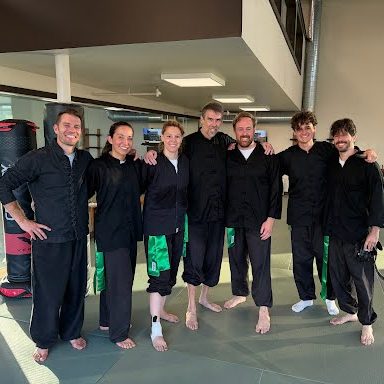
Cory Caplan
About ten years ago, I dragged three of my friends to what would be the last Soundgarden concert at The Forum. And in the middle of what was probably our third round of overpriced lagers, I got a phone call — which perturbed me because I had my phone on “Do Not Disturb”, so somebody had called me using an “Emergency Bypass”. It turned out to be my then 91-year-old grandmother. A little alarmed, I picked up to ask if everything was okay.
Now, she’s a very soft-spoken old Jewish woman, and sadly her voice could not compete with the 120-decibals of high-octane stadium rock. So, I couldn’t hear a thing she was saying except for a few frantic phrases like “stuck” “can’t move” and “I think it might be broken.”
I instantly texted my dad — her son — to check up on her as I made my way out of the venue to call her back. But unbeknownst to me, when I picked up, all she heard on the end of her line was, quote “very loud, horrible screeching” — which I guess is her opinion of Grunge. So, she, in turn, also called my dad to make sure I wasn’t in any trouble.
When the dust settled, it turned out we were both completely okay. Apparently, in a bid to keep my grandmother up-to-date with the 21st century, my dad had gotten her a smart watch. And for some reason, the watch face was “stuck” on 3:15, “can’t move” and she was afraid — “it might be broken.” So, being under 30 and therefore family tech support, I was tasked with driving hungover to Woodland Hills the next morning to go fix my grandmother’s watch. And not to brag or anything, but I did it in under five seconds.
It turned out after unboxing it, she never removed the thin piece of plastic on the watch face that shows the sample display. Now my grandmother was a very proud woman who really did her best to keep up with the times. So, when she asked me how I fixed it — I told her I needed to hack the main frame of her watch’s processing server.
But when I was driving home, I actually started to feel pretty bad about saying that. My grandmother wasn’t embarrassed about not understanding the watch. I was embarrassed on her behalf. Because in many ways, I thought of her as a senior student of life. She had raised five kids. Held down two jobs. And watched the world change countless times. At ninety-one, she had forgotten more about resilience, sacrifice, patience, and family than I had even begun to learn. The only reason I looked like an expert in helping her was because I happened to be standing on a very small hill that she had never needed to climb before. And when I started thinking about this paper, that was the memory that kept coming back to me.
Because even before this test, sometimes newer students come to me for guidance on techniques or ask me how to get over a fear of sparring. But I know full well I’m still making countless mistakes. My techniques are far from perfect. By the time I’m reading this, I’ve probably already been hit in the head several more times. So how do I keep from feeling like an imposter knowing there are things I’m sometimes getting wrong that might feel as basic as peeling the plastic off an Apple Watch?
To be honest, I’m not entirely sure. But I think it may have something to do with remembering that “student” is still the operative word in “senior student”. Over enough years of practice, looking foolish once in a while is inevitable — even with a more advanced sash color. Which means that, more than ever, as a senior student, I need to want someone to correct me. To pull the plastic off my watch, as it were. Whether it’s Sifu, or someone who hasn’t earned their White Sash yet. It never matters where real help comes from, as long as it’s given. And ironically that’s something I’m going to have to remind myself of when I feel like an imposter helping others. Or when I’m a big sweaty mess reading a paper to my peers who can now all put me in at least 27 different locks, chokes, and throws.
Ana Sopalovic
I started kickboxing at 12. My father was a professional athlete and a coach. He trained alongside my older brother and me — always watching, always coaching. I loved it.
By 15, I’d been training with the same boy for years. Same age. One day he decided to go too hard. He was busy fighting the teen boy demons. And I wasn’t going to be weak about it. My dad was watching.
He told the boy to stop a few times. Then he stopped the whole practice. You have to stop. The boy complained. His father backed him up. My dad — the biggest person in the room — looked at the trainer and the whole class and said: Do you think I’m not restraining myself with all of you?
The trainer made excuses. We grabbed our stuff and left. All three of us. We never came back.
My dad didn’t know he was teaching me what a senior student is. But he was. He knew exactly what he could do. And precisely because of that, he chose not to. Ego is what my dad taught me how to walk out on.
In a lot of places, martial arts is purely physical. Hit harder. Move faster. Dominate. There are gyms built entirely around that. What we do here is different. The physical is the foundation — it’s real and it’s hard — but it’s a vehicle. This is a spiritual journey built on the physical. That changes what we’re after. It changes who we are to each other.
What looks impressive and what actually works are not the same thing. After a specific strike, where is the person standing? What’s the geometry? A flying kick might be the worst possible choice in that moment. We know our own structure — our injuries, our height and weight, what flows and what we’re still building. By green, we’ve had enough reps to feel the difference. Not in theory. In our bodies. That’s part of what we’re actually testing.
Nobody dragged us here. We kept choosing this — through every session that left us sore, through the weeks where nothing clicked, through exhaustion that somehow still brought us back. Pain is part of the deal. We accepted that a long time ago. Suffering is a choice. The one that actually forges the soul is choosing not to. That’s why we keep coming back.
Which means the responsibility to others is real. All students need to feel safe with us. Safe enough to push, to fail, to push again. The question is ours now: do we not recognize that the person in front of us is also restraining themselves, making space for us? Restraint is care. It’s how we hold each other. It’s how the Dojo persists as a space for growth. For all of us.
A senior student is a reference. People watch how seriously we take our own discipline. How much we care about others. Whether we show up — for ourselves, and for the people around us. That tone gets set whether we mean to set it or not. Green means we’re being trusted to carry the legacy forward.
The sash is not just a rank. It’s a record — the hours, the choices, the pain accepted and the suffering refused. It carries the dojo. Sifu. The training partners who pushed us and the ones we protected. It represents an environment that held us long enough for us to become someone who can hold others.
Honoring it means knowing what it actually is. Not a trophy. A commitment.
Andrew Collyns
If you’re hearing this, that means I’m not dead. It also means that you’re not dead. To be honest, I’m probably feeling a little shocked. Not about you, me. Maybe a little bit about Adam. But rest assured, I had faith in the rest of you.
I started really focusing on my prep for this test only three weeks ago. A mistake I will never make again, unless Sifu places our 2nd degree green sash test near my finals exams again, in which case… this may happen again. But if I’m reading this right now, it means that somehow, some way, I managed to pull this off. As Mike likes to remind me, I’m the same person who taught myself mirror form in a weekend a year and a half ago. So of course I could do this. I knew myself well enough to know that somehow, I could do this. And that’s what I think is important to being a senior student… knowing yourself, acknowledging yourself, and the journey you’ve been on.
What do I know about myself? I know that I’ve been practicing here for seven years. I know that I have the experience of someone who’s been here for seven years, and I know that I can use that experience to help others. It’s both a responsibility I choose to take on and a responsibility I’m expected to take on. Junior students and the students I teach expect me to live up to a certain standard, a standard that they can learn from. I’m expected to be knowledgeable enough to be able to have followed along and get these techniques right. I’m expected to be able to answer questions that students may have to the best of my ability. And I choose to meet that expectation. I choose to stay here, knowing the inevitable, that some soul will wander on to the mats and need a question answered, and I will be there to answer that question to the best of my ability.
My ability. There lies the second part of the question. Although I am a senior student, I am still a student. My high school Spanish teacher once told me, “When in doubt, Andrew, you’re always right.” It’s taken some time for me to reconcile with the fact that he wasn’t 100% percent serious when he said that, but I got there eventually. The truth is that I’m not always right. I don’t have the answers to everything. In those moments, I need to have the humility to admit to myself and that student that I don’t know, then promptly tell that student to ask Mike or Ann instead. But when I do that, I don’t just leave that student to go find that more senior student, I also must see that senior student to fill that gap in my knowledge, so that next time that happens, I will know how to help the next person.
I have come a long way, I have learned so much, I can help people in their martial arts journeys, but I must always remember that I am still a student and there will be many more times where Sifu calls me out for being tall and not using that to my advantage. There will be some times where Mike will call me out for accidentally extending my hands out during sparring. But there will also be some times where I land some good combinations on Mike. And he will fulfill his duty as a senior student by congratulating me on giving him morning pain. More failures are to come, but also more successes, and all of that will aid me in being a better martial artist as well as being a senior student. I’ve missed out on so many life mistakes because I had my older brother who made those mistakes for me. Now I get to be the older brother. I get to be the one who’s gone through it, learned from it, and gained wisdom from it. And those experiences will benefit me, and I will make sure I use them to benefit those around me to the best of my ability.
Greg Griffin
Finally, a topic I know a lot about. Being a senior student means parts of your body start hurting for no reason at all! – or sometimes your bones will crack loud enough to be heard from a couple mats away. But this would be a pretty boring paper if it was just a bunch of complaints about aging – so – my ideas about what it means to be a senior student fall into two categories: things I know from firsthand experience, and things that I don’t know but have aspirations toward.
There’s nothing especially unique about my experience with senior students – I bet most students would describe something similar – but common or not, I’m going to share what senior students have meant to me. There’s only two things, won’t take long:
1. They inspired me.
To a beginner struggling to get anything right, senior students seemed to perform magic tricks – always moving and responding the right way, where I was constantly messing up. But it wasn’t just their knowledge that inspired me – it was their work ethic up there in the front row. It posed a question: is pushing hard something that happens naturally for senior students, or are they senior students because they push hard? Most important of all, they showed me that challenges that I found intimidating were actually possible to achieve – like passing a difficult test, or even joining an advanced class. They all faced the same challenge and figured out a way, so what’s my excuse?
That was how senior students inspired me, and now…
2. They supported me.
It’s rare for me to work with a senior student and not have them point out something weird or flat-out wrong with my technique that, up to that moment, I was totally oblivious to, and would have continued being oblivious to until the end of time had they not spoken up. They helped me through moments of insecurity and doubt by sharing an encouraging word, or by pushing me a little outside of my comfort zone. They redefined what it meant to win: celebrating something I finally got instead of anything they might have been doing themselves. All of these are forms of support – and forms of generosity. More recently, in t’ai chi I’ve learned that taking the role of the supporter has its own rewards: having to teach something is an incredibly effective way to find out how much you really don’t know and need to work on. Both roles, the supported and the supporter, get something out of the relationship.
Moving away from direct experience to qualities I aspire to as a senior student – these might be a little more particular to me, and started out as a list of three things, then two things, and then just one thing. The more I thought about it, the other things were just reflections of this one idea. And that idea is, the senior student I aspire to be erases the distinction between in the dojo, and outside the dojo.
Obviously, that doesn’t mean I want to walk out the door and punch someone in the face. First and foremost, I want to keep working on the questions that drew me here in the first place:
- How do I relate to failure?
- How do I respond to something that’s difficult or scary?
- How does my mind relate to my body?
- When is my ego taking over?
…and so on. These questions do not politely confine themselves to the time that I spend here. My practice inside the dojo helps me carry freshly reinforced and refined answers outside, where they have a chance to produce real benefits for me and everyone in my life. I don’t know what role these internal and spiritual questions play with senior students in general, but for me, they’re the foundation that everything else sits on.
Another way of putting it, and to start wrapping this up, is that the qualities of senior students that I’ve experienced and described here today – the work ethic, the generosity, inspiring by example, and so on – shouldn’t only exist inside these walls – and my goal, difficult though it might be, is to not only embody those qualities here, but out there.
Lastly, my experience here taught me to be more intentional in finding senior students out there in the world, to make any difficult, scary goal more approachable. And to be the senior student for others, to the best of my ability, whenever I can – not just to be a nice guy and maybe help them out, but because it rewards me too.
Vanessa Kim
A few weeks ago, my ten-year-old son Carter and I were practicing combinations together at home. He’s been in the kids classes for the last year or so. He wanted to make suggestions for my combinations for this test. Carter really wanted to pull out all the stops. For example, he really wanted me to incorporate a tornado kick to a hook kick to a haito (or something crazy like that). I tried explaining to him that 1) I probably don’t have the capacity to pull that off very well and 2) I’m not sure that it’s a realistic combination. When he asked “why” I struggled to come up with a good explanation. Even after years of my own training, and now entering this chapter of becoming a “senior” student, it dawned on me that I still have so much to learn in order to impart any knowledge or skill to others.
When I started practicing four years ago, I imagined that by this point I’d be walking around here with much more clarity and certainty. Instead, every new technique, every partner, and every challenge has revealed another layer of learning. The higher I climb, the more I see how far the mountain extends. I see clearly though that mastery is not about reaching a destination, but rather being humble enough to learn, absorb, and grow from every point in the journey.
It’s a similar lesson to one of the key themes in Zen in the Art of Archery. The student spends years trying to learn how to release an arrow correctly. Again and again, he focuses on hitting the target, only to be reminded that the target is not the point. The real lesson is learning how to remain calm, patient, and trust the process.
When I first began studying kung fu, I was drawn to it for practical reasons. I wanted to get stronger, learn self-defense, and set a good example for my two sons. What I did not expect was how much the practice would challenge me mentally and emotionally. I have experienced moments of confidence and moments of frustration. I have struggled with techniques, endured injuries, questioned my progress, and wondered whether this practice was sustainable. These experiences have taught me that mastery is not measured by how easily a person performs a technique, but by how they respond when things become difficult.
Part of that response also means accepting support from others. Throughout my training, I have been fortunate to have more experienced students guide me through difficult moments and have stepped in with encouragement, perspective, and practical advice.
People like Chaya and Mike who have offered to practice with me outside of class, listened when I was struggling, and reminded me that setbacks are a normal part of training. Injuries are not evidence of failure or incompetence. They are simply part of the process of learning and growing. Their support showed me that a senior student is not someone who stands above others, but someone who helps lift others up.
I am also incredibly grateful for and inspired by my fellow test mates today. I see all of you as such strong, grounded, and highly skilled people. Truly the best part of preparing for today’s test has been practicing with and connecting with you all on a deeper level.
Greg – My testing partner since our white sash days. You’ve been so dedicated and committed to your practice, and it has pushed me to keep up. I am pretty sure you were the first one of all of us to complete 2nd form and had it fully memorized front and mirror at least 6 months ago. I continue to be inspired by you and am grateful to confide in you all these years.
Corey – You have all of the components to be the toughest guy here, yet every time I see you with a new partner, you have this incredible ability to see exactly what they need and dial it up or down perfectly to be the best partner in the room.
Adam – For someone who has practiced literally every kind of martial arts in his lifetime, you are the most humble and kind human being. It’s no wonder why you have such incredible skill! I used to think I had one of the highest crescent kicks until I met you. Your friendly and fun attitude is one of the reasons I love to practice with you and just reinforces that kung fu can be fun.
Ana – My fellow lady boss today! I see you as such a strong, no-nonsense person, which I love. You get in, do the work, give it your all, and keep going. Literally like a boss! Yet at the same time, you’ve shown so much kindness and support, offering advice and helping me perfect my techniques when you saw I was struggling. I’m so thankful for that.
Andrew – I’m pretty sure you’ve been practicing here the longest, and it’s been so helpful to have you as a supportive resource and partner. More importantly though, I’ve seen you become such a role model to all the kids in this dojo. Carter loves Mr. Andrew’s class – he’s like the cool older brother he wished he had. As a mom it’s heartwarming for me to see how he truly listens to you when you impart your life’s wisdom whether it’s in class, or washing the windows upstairs together. And so we’re both grateful for you.
Years ago I began this martial arts journey hoping to become stronger, healthier, and more capable. Today, I realize that kung fu has given me much more than that. It has taught me patience, resilience, humility, and the value of community.
To sum this all up, I now realize that being a senior student is not about having all the answers. In fact, it may be the opposite. A senior student is someone who lifts others up and understands how much there is still left to learn. It is someone who remains teachable, humble, and committed to the process of growth. That is what I hope to continue and to teach my children. Watching Carter’s enthusiasm for kung fu grow has been one of the most rewarding parts of my own martial arts journey. Even if I can’t always do the combinations he suggests, practicing together at home has given us something special to share, including sharing my own worries, frustrations, and excitement around this test. I just hope that by seeing my commitment, he learns that growth requires effort, persistence, and courage. If my dedication has played even a small role in encouraging him to pursue his own goals, then that is something I am incredibly proud of.
Adam Stoker
When I first started at School of Martial Arts 3½ years ago, I texted my friend excitedly and told her, “I found it!” For months, I had been searching for a Martial Arts dojo that balanced the physical, spiritual, and social elements of Martial Arts, and truly embodied what it professed. Martial Arts had been a part of my life for most of the time since I was 12 years old, but for the previous 5 years, I was not actively training. I had recently, however, come to realize that being a Martial Artist is part of who I am, and that I needed to get back into it.
So, despite being incredibly busy with my internship and finishing graduate school, I started searching. When I started training, however, I felt it important to let people know that, though I was a beginner, I was not ACTUALLY a beginner, because I had done Martial Arts for years. It felt important that people knew that I knew more than my sash (or lack thereof) showed.
So, I sought to prove myself. During ki-hon, I would try to sneak in some advanced techniques. The first time Sifu let me spar in day class, I whipped out a spin hook kick to prove that I knew my stuff. Unfortunately, I hadn’t actually shared with my partner that I had sparred before (sorry Angie!). I felt I had something to prove. I have never considered myself to be egotistical, but in those moments, my ego was running the show.
A few months in, however, I pulled Sifu aside after class and told him that I felt like my technique was worsening. He shared (perhaps with a bit of sarcasm mixed in), that my technique was not worsening, but rather my awareness was improving. I was learning the ways that my body does not move the same as it did when I was 15. I was learning the differences between my old styles and my current styles. I was learning that technique that is pretty may lack practicality and vice versa. I was learning a new style which felt a bit like learning Italian when I had previously learned Spanish. There were parts that translate, but so much of it was new.
Since then, I have come to realize that, although much of my prior training is applicable, there is endless room for growth and improvement. In many ways, my prior training has given me a solid training foundation and an appreciation for the Martial Arts; however, in others, it has served as an impediment due to differences in technique, sparring rules, etc. (Hands up, Adam!).
I have also truly grown to appreciate the spiritual elements of Martial Arts. Outside of the dojo, I am a Psychologist and work daily with children and adults struggling with anxiety. Ask anybody who did the meditation test with me this week—I definitely struggle to control my own anxiety at times. During the test, however, which was the longest I have ever meditated, my mind finally became quiet—to the point that I was surprised when Sifu came in and told us that time was up. The last time I felt that was at my first internal retreat where we had 24 hours of no talking. My mind protested, became loud, then became silent and calm. It was truly a spiritual experience, and the calm was a welcome break for my usually very busy mind.
So, what does it mean to me to be a senior student? It means that, even if I have more advanced technique, I maintain a beginner’s mind and a recognition that there is endless potential for improvement. It means that I regularly practice control of my mind and my body. It means that the knowledge that I have of Martial Arts does not belong to me. It is my responsibility to share what I know and help others improve. The paradox of being a senior student is that the most important part is realizing that I am, in fact, still a beginner and have much to learn.

Taunia
👏👏👏👏👏👏